Paths Greenways Bridleways Tracks
PGBT

At common law, highways can be footpaths, bridleways or carriageways. Any other status requires an Act of Parliament to make it possible. The Cycle Tracks Act 1984 provides legal recognition to a public right of way on foot and cycle.
Section 3 says,
“(1) A local highway authority may in the case of any footpath for which they are the highway authority by order made by them and either-
(a) submitted to and confirmed by the Secretary of State, or
(b) confirmed by them as an unopposed order,
designate the footpath or any part of it as a cycle track, with the effect that, on
such date as the order takes effect in accordance with the following provisions of
this section, the footpath or part of the footpath to which the order relates shall
become a highway which for the purposes of the 1980 Act is a highway maintainable at
the public expense and over which the public have a right of way on pedal cycles
(other than pedal cycles which are motor vehicles) and a right of way on foot.
(2) A local highway authority shall not make an order under this section designating
as a cycle track any footpath or part of a footpath which crosses any agricultural
land unless every person having a legal interest in that land has consented in
writing to the making of the order.”
Converting the whole width of a footpath removes it from the definitive map, and so makes it harder for those unfamiliar with the area to find a path. However, the conversion of a footpath to a bridleway would give cyclists the right to use it but would retain the path on the definitive map, so making it easy for the public to find the route.
Where a route is a footpath, bridleway or restricted byway, or is shown on the definitive map as a restricted byway or byway open to all traffic, the public have rights to enforce removal of obstructions that are not available for non-definitive map routes. Section 130A Highways Act 1980 allows notices to be served on the highway authority to cause action to be taken, with recourse to the courts if nothing is done, but this facility is only available for routes that are footpaths, bridleways or restricted byways, or are shown on the definitive map as byways open to all traffic. It does not extend to cycle tracks.
To ensure the public retains its rights against obstruction, a path should remain on the definitive map.
Where an order under the Cycle Tracks Act 1984 is considered, the council will need to consult, make and advertise any order, and confirm and advertise at the end of the process. If the order is opposed, the council will need to refer it to the Secretary of State, and be responsible for the costs of advertising and hosting a public inquiry.
If landowner does not agree to an upgrade, an order would be needed under s.26 Highways Act 1980 in which case costs will be similar to those under the 1984 Act.
However, where the landowner seeks to change the footpath to a bridleway (which allows for cycling), this can be achieved by a public path creation agreement under s.25 Highways Act 1980. This has no provision for objection and only requires one advertisement rather than two. The process is also able to be completed in a few months, whereas opposed orders usually take much more than a year because of the need for the public inquiry process.
Provision of a bridleway rather than a cycle track is a best value proposition (in accordance with the general duty under s.3(1) Local Government Act 1999). With landowner agreement bridleway creation is cheaper than cycle track creation (and so is more economic). It is more efficient as it requires less use of council staff time, and it is more effective as it provides facilities for a larger slice of the non-motorised population (that is, riders as well as walkers and cyclists).
The Patchetts Green Bridleways Trust recommends that footpaths that are to be allowed for cycling should instead be upgraded to bridleway status under s.25 Highways Act 1980. Where a landowner agrees to an upgrade, it can be achieved more quickly and at less cost than an order under the Cycle Tracks Act 1984.
This is an example of bridleway creation by public path creation agreement to create cycle rights.
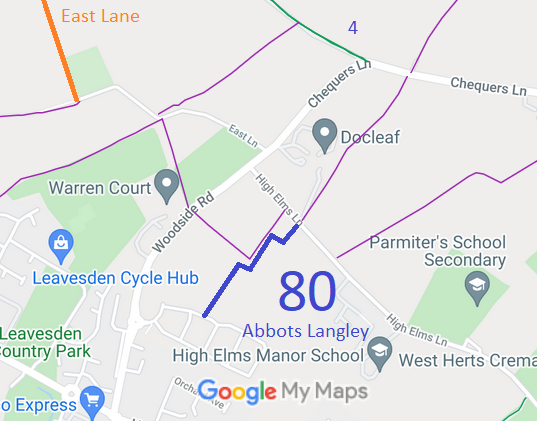
This route was designed to link a new development at Woodside Road, Abbots Langley to the cycle track alongside High Elms Lane (public road). It was created on 12 Aug 2016 by public path creation agreement between the County Council and the Developer as the most cost effective way of ensuring cycling rights.
The Cambridgeshire County Council (Public Footpath No 9 Saint Ives and Public Footpath No 10 Parish of Houghton and Wyton) Cycle Tracks Order 2014 attracted objections from local riders, the British Horse Society and others. The public inquiry took place on 22 and 23 March 2017. The final decision letter (reference NATTRAN/E/CT/92) from the Secretary of State was dated 10 May 2017. The order was not confirmed. While each order must be considered on its own merits, this example does give an indication of the time taken for an opposed order to be processed and is an example that shows that the Secretary of State does not simply agree with the order making authority but will examine all the issues carefully.
While every endeavour has been made to give accurate information, the law is complex, subject to different interpretations and subject to change. The contents of this website are offered to help registered supporters and general readers, but do not constitute formal legal advice.