Paths Greenways Bridleways Tracks
PGBT

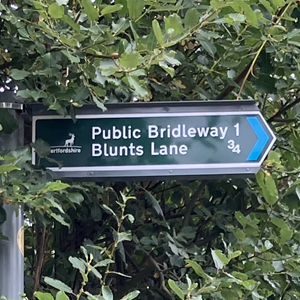
People unfamiliar with the area may not know exactly where paths start from the public road. As a result, the Countryside Act 1968 requires highway authorities to signpost where the path meets the metalled road.
Section 27 says,
“(2) Subject to subsection (3) below, at every point where a footpath bridleway, restricted byway or byway leaves a metalled road the highway authority shall in exercise of their power under subsection (1) above erect and maintain a signpost—
(a) indicating that the footpath, bridleway, restricted byway or byway is a public footpath, bridleway, restricted byway or byway, and
(b) showing, so far as the highway authority consider convenient and appropriate, where the footpath, bridleway, restricted byway or byway leads, and the distance to any place or places named on the signpost.
(3) A highway authority need not erect a signpost in accordance with subsection (2) above at a particular site if the highway authority, after consulting the council of the parish in which the site is situated, or as the case may be the chairman of the parish meeting for the parish, not having a parish council, in which the site is situated, are satisfied that it is not necessary, and if the parish council, or as the case may be the chairman of the parish meeting, agree.”
While every endeavour has been made to give accurate information, the law is complex, subject to different interpretations and subject to change. The contents of this website are offered to help registered supporters and general readers, but do not constitute formal legal advice.